
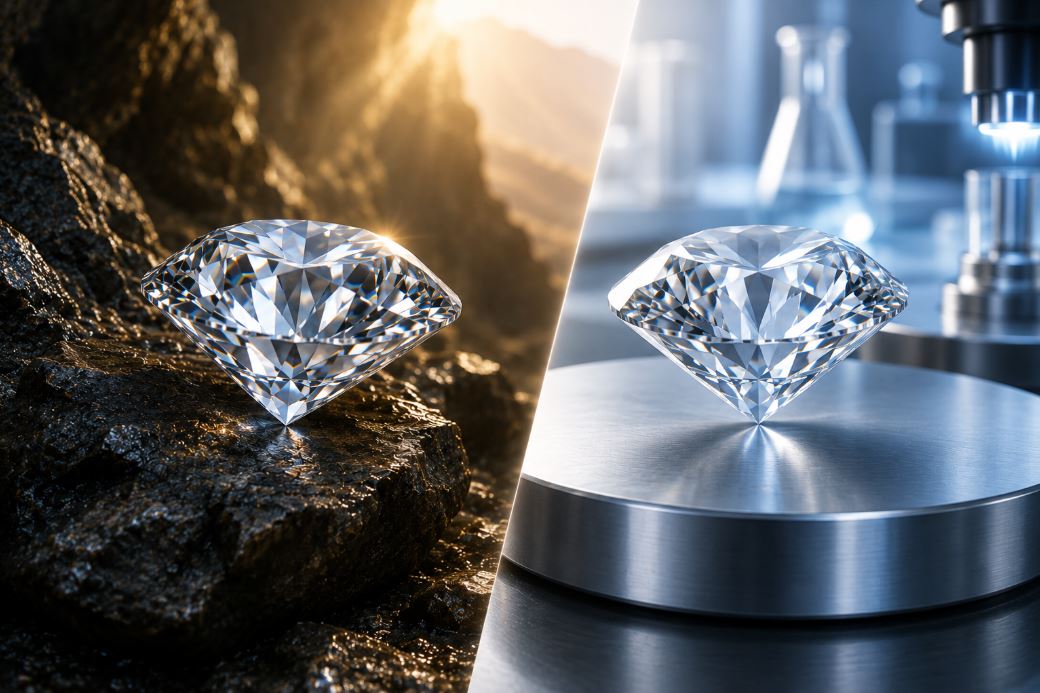
Before diving into the pros and cons, it helps to clear up the biggest misconception right out of the gate.
The Physics: Lab-grown diamonds are not fake. They are optically, chemically, and physically identical to natural diamonds. They are made of pure carbon structured in a crystal lattice, boasting the exact same score of 10 on the Mohs hardness scale.
The only difference is their origin: one was forged by nature deep underground over billions of years, while the other is grown in a high-tech lab over a matter of weeks using advanced methods like Chemical Vapor Deposition (CVD) or High Pressure High Temperature (HPHT).
The Comparison Matrix
To see how they stack up at a glance, here is how upfront costs, value retention, and consumer values intersect.
| Feature | Natural Diamonds | Lab-Grown Diamonds |
| Upfront Cost | Premium pricing; traditional luxury asset | Up to 70% to 80% less than a natural equivalent |
| Resale/Trade-in Value | Retains a stable percentage of market value | Minimal to zero secondary market resale value |
| Rarity | Finite, natural resource | Mass-produced; supply scales with technology |
| Purchasing Power | Standard size for the budget | Allows for a significantly larger carat size for the same budget |
The Pros and Cons Breakdown
1. Natural Diamonds
                  PROS                                      CONS
┌───────────────────────────────────────┐ ┌───────────────────────────────────────┐
│ • Time-tested inherent value          │ │ • Premium upfront cost                │
│ • Finite scarcity & rarity            │ │ • Smaller carat size per dollar       │
│ • Traditional heritage                │ │ • Tracing origin requires strict      │
│ • Eligible for store trade-in programs│ │   certification (e.g., GIA/GSI)       │
└───────────────────────────────────────┘ └───────────────────────────────────────┘
The Deep Dive:
- The Value Proposition: Natural diamonds carry a premium because their supply is inherently limited by nature. Because of this scarcity, they hold a recognized market value over time. For a buyer who views an engagement ring or a significant jewelry piece as a lasting family heirloom with intrinsic financial worth, natural is the definitive choice. They are also widely accepted in jewelry store trade-in and upgrade programs.
- The Budget Impact: You are paying for that rarity. Choosing natural means either allocating a larger portion of the budget or compromising on the size (carat weight) or quality (color and clarity) to stay within a specific price limit.
2. Lab-Grown Diamonds
                  PROS                                      CONS
┌───────────────────────────────────────┐ ┌───────────────────────────────────────┐
│ • Incredible budget flexibility       │ │ • Little to no long-term resale value │
│ • Maximizes carat size and clarity    │ │ • Rapidly falling market prices due   │
│ • Identical visual performance        │ │   to unlimited production capability  │
│ • Clear, controlled origin chain      │ │ • Not typically accepted for future   │
│                                       │ │   trade-in/upgrade programs           │
└───────────────────────────────────────┘ └───────────────────────────────────────┘
The Deep Dive:
- The Value Proposition: The primary driver for lab-grown diamonds is staggering affordability. Because technology has streamlined the manufacturing process, the cost to produce them has plummeted. This allows a buyer to maximize their budget, often walking away with a 2-carat or 3-carat diamond of exceptional clarity and color for the same price as a 0.75-carat natural stone.
- The Budget Impact: While the upfront savings are massive, buyers must understand that a lab diamond should be viewed as a sunk cost, much like buying electronics or a vehicle. Because factories can print more stones as technology improves, lab-grown diamonds do not retain value on the secondary market, and most retail stores cannot offer trade-in value for them down the road.
Aligning the Decision with Personal Values
To help your clients navigate the final choice without feeling overwhelmed, anchor the decision to what they prioritize most:
Choose Natural If Your Value Is: Heritage and Tangible Wealth
If the idea of a stone that took a billion years to form appeals to your sense of romance, or if you want comfort knowing the piece holds a baseline of global commodity value that can be passed down or traded in later, natural is your match.
Choose Lab-Grown If Your Value Is: Practical Impact and Visual Scale
If your primary goal is to get the most breathtaking, eye-catching piece of jewelry possible within your current budget, or if you prefer to divert those upfront diamond savings into a down payment on a house, an unforgettable honeymoon, or an intricate custom setting, lab-grown delivers unmatched practical value.